

How To Win (Or Lose) Money by Betting on the Oscars
Gambling on the Academy Awards is going mainstream. I asked an experienced friend for advice.
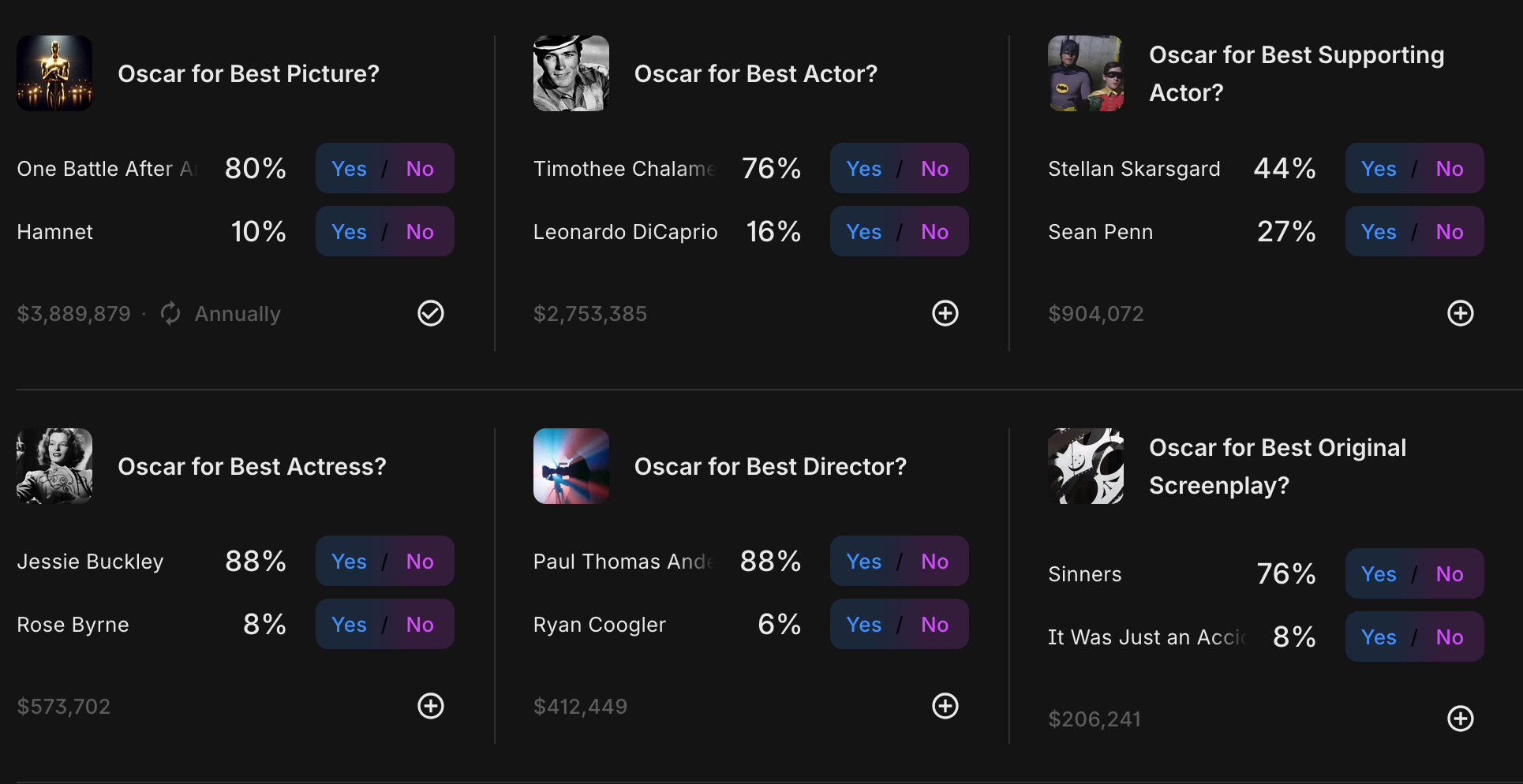
The Fanduellification of the Oscars has begun.
During last week’s Golden Globes, viewers were shown live “predictions” for some of the categories. Coverage of movie industry awards has always resembled sports (and politics), but this was the first time betting was acknowledged during an official telecast. While the Golden Globes are never meant to be taken seriously, it feels like a portent.
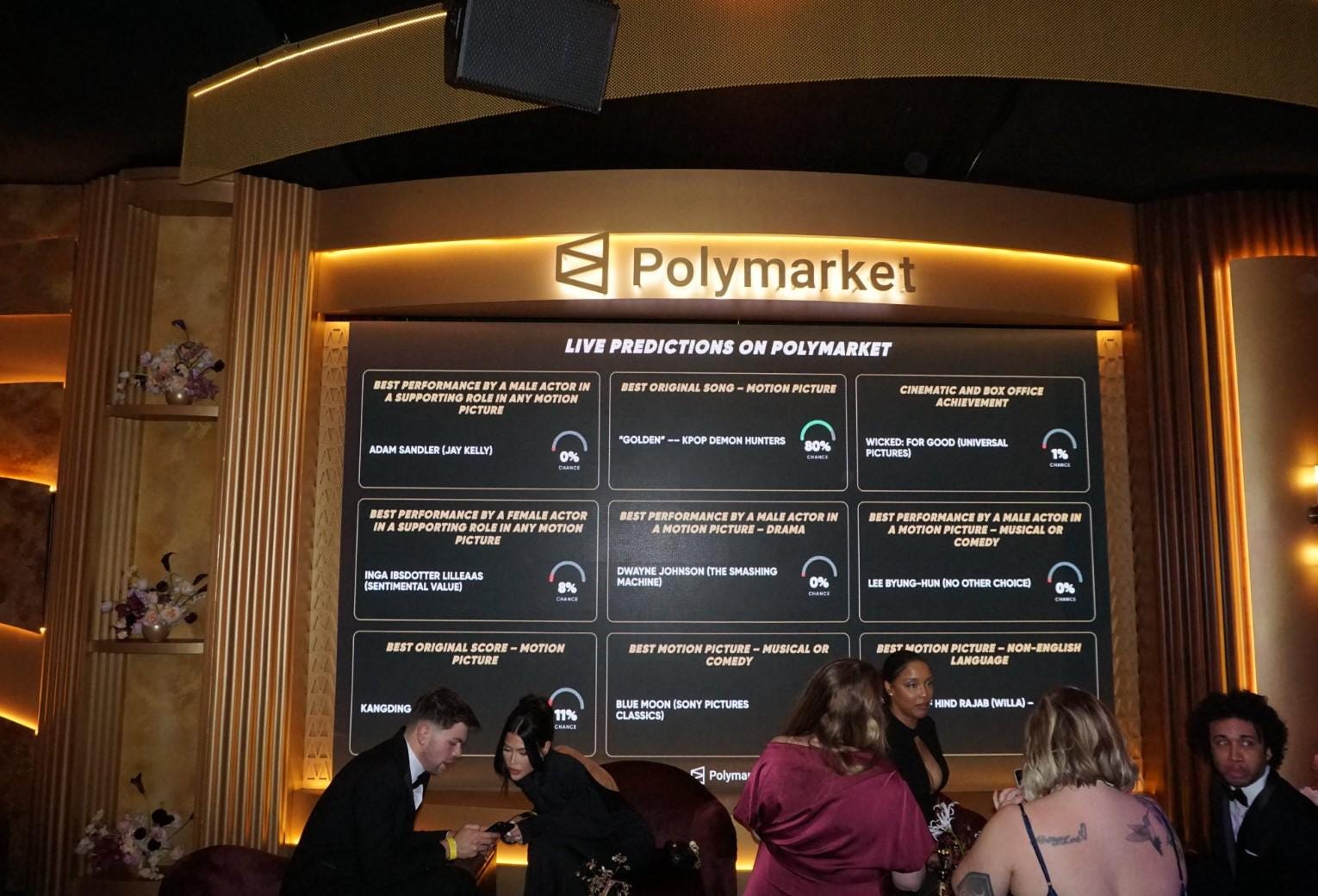
Just as online sportsbooks have transformed how people talk about sports, prediction markets like Polymarket and Kalshi threaten to do the same for literally everything and anything. You can place bets on the Oscars, Rotten Tomatoes scores, the length of a White House press conference, and bombing Iran. These companies would want you to know that technically, you are not placing bets but purchasing event contracts. Legally this is not gambling, but who is being fooled? (NPR just published a great report on the rise of this rapidly maturing not betting economy, which is worth a read if you wanna delve into this more.)
That said, if you can’t beat the odds, join ‘em. I’m not an experienced gambler by any means. Everything I know about sports betting I learned from Adam Sandler’s seven-way parlay in Uncut Gems. You wouldn’t want me giving advice, I called up a friend who knows much more about Oscars betting than I do.
Jason is a management consultant who has never lost money in his seven years of betting on the Oscars. (His last name is withheld for privacy reasons.) Originally he went through a bookie, but last year he switched to placing his bets on Kalshi. We had a very nerdy discussion about how prediction markets differ from traditional sportsbooks, how optimal betting strategies are more complicated than just picking winners, and his narrative for this year’s race.
Paid subscribers can get access to Jason’s full analysis, which he was kind enough to share with the class, as well as any updates in the weeks to come.
Interview With the Gambler
Or, the rewards of risk.
Jason and I spoke on January 12, the day after the Golden Globes. Specific probabilities/odds discussed have changed since then. The statements and predictions in this article are meant to be used for entertainment purposes and should not be construed as financial advice. This interview has been edited and condensed.
Thanks for chatting with me about the wild and wonderful world of betting on—sorry, predicting—the Oscars.
Predicting, yes. It is legal if it’s a prediction market. We’re not betting. We’re not gamblers here!
No, it is gambling, but in the way the stock market is gambling. I think the line conceptually and maybe morally is pretty blurry. And it’s really just about the regulatory structure. The way I think they justify it is they say “we’re just a tool to aggregate information.”
When did you first get into Oscars betting?
I had gotten good at the usual Oscars pool, like when you go to an Oscars party and everyone makes their picks. Around 2018 it came up in conversation with a friend of a friend who runs an underground poker ring. That’s like his full-time job, he’s had [a certain former NBA star] show up to his games.
He was like, “Dude, if you’re actually good at predicting the Oscars, like let’s put some money down. I know a bookie.” It was just me picking what I think is going to win, and then him making sure the odds were worth betting on. We weren’t going to bet on anything where a film was an 80-90% favorite.
The first year we did this was for the ceremony in 2020. This was the Parasite year and I got super lucky. We did not bet on every category, but the ones we did, we got all of them right.
A lot of people heard us brag about it so the next year, we got a big group together to put a lot of money down. And I do terribly, like really terribly. I got everything wrong except for Frances McDormand in Best Actress. But that won us all of our money back and we just broke even.
After that, I started getting more visibility into how the oddsmaking worked and would place flyer bets. We wouldn’t just bet on things that I thought were going to win, but things that were mispriced.
And how did you do last year?
My group put down a total of $15,000 across 12 categories. Our adjusted odds were around 61% and we hit on 87%, so we outperformed our odds. We made about a 50% margin.
So your profit was $7,500.
Exactly. I just pick things and then people just pony up money. We’re a bit like a venture capital firm. I prepped a spreadsheet for every single category and wrote down my takes. Some people make their own bets on the side based on that.
What makes Oscars betting more appealing compared to sports?
Right now, you don’t have to be super sophisticated. You don’t need a mathematical model to have an edge. It’s about narrative and that is a much harder thing to mathematically measure. You need to understand trends and tones.
Last year you switched from a traditional bookie to betting on Kalshi. What was the reason?
There were two reasons. One is that the odds were better for us. Kalshi is more volatile than underground betting, but that means more opportunity to be had.
And then two, it was easier. We didn’t have to worry about pooling money together to clear a minimum bet with a bookie. That was a big thing. With Kalshi, we actually have the opposite problem. Once you start putting in enough money, you’re demonstrably changing the odds.
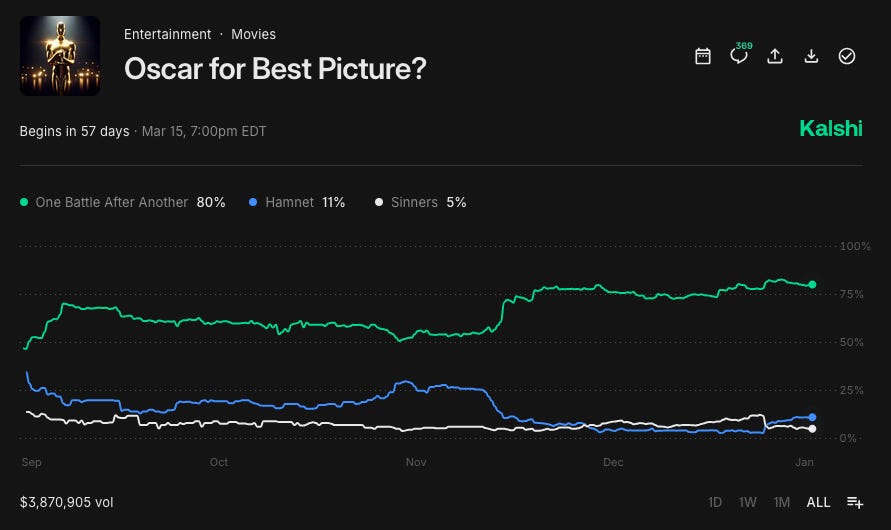
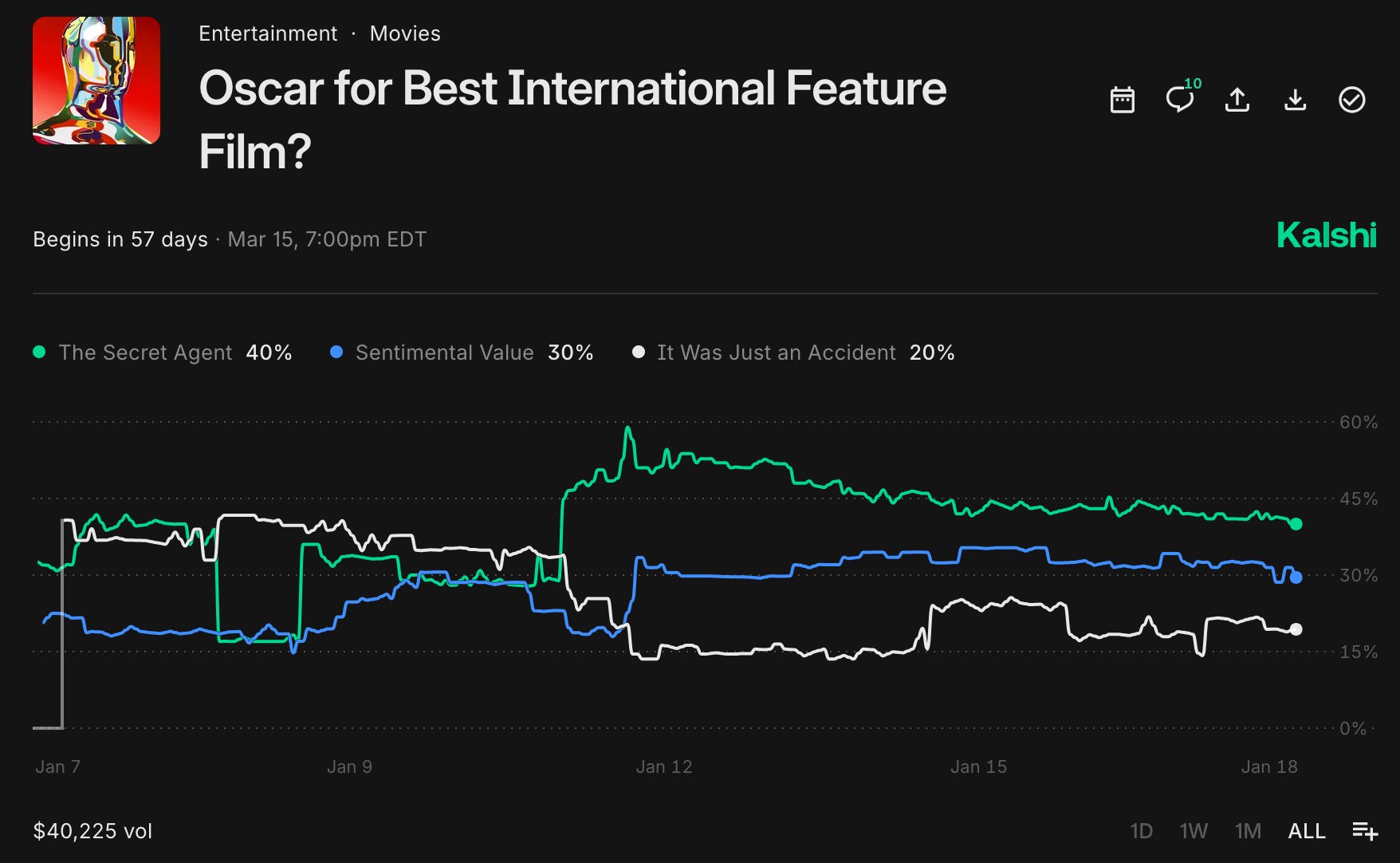
That was something I was looking at, the total market volume. Best Picture has almost $4 million in play but International Feature only has around $30,000. If I put $1,000 into that category, it’s going to move the odds dramatically.
That’s actually why I’m not putting more money into International Feature. The amount I wanted to put in would have moved the odds to a point where I didn’t want to be in anymore. That didn’t happen with a bookie, where the lines were fixed. It doesn’t happen in sports betting either, because the volume is so high that no single bettor can really move the line.
It’s the opposite of the stock market. In the stock market, it’s better to have a big position because you can start to influence the company. Here, it doesn’t pay to be a big fish in a small market.
Unless you start holding Academy members hostage.
We don’t need to go into market manipulation. I’d encourage anyone who believes in a big Oscars-rigging conspiracy to do some research into how the voting and auditing actually work. I’m not a truther.
What’s your starting point with making your predictions?
I have a set of heuristics that I follow, a set of Oscars truths. One of my heuristics, and I think this is what people get wrong more than they get right, is that there’s usually a narrative for the night. These awards are not isolated events, there’s correlation. It’s Pennsylvania and Ohio in the presidential election. That being said, every category does exist on a spectrum. Something like Best Director is probably the best example of correlation with Best Picture.
But there are other categories—the technical ones more than others—where there isn’t a correlation. Sound is a great example of this. Does it matter how good the movie was? Not at all. Does it matter how good the sound was? A lot.
I think about Suicide Squad winning the Best Makeup Oscar. People were a little confused and I was like, “Well, they’re not awarding the best movie with makeup. It’s the best makeup in a movie.”
Great example. There’s a difference between predicting what Academy voters like and what they are going to judge as a better-crafted movie, especially in branch-specific categories. And that’s a core part of my philosophy, to watch the movies and separate the two.
Do you look up or calculate any stats, or are you mostly going on instinct?
Both. I’ve looked at the numbers over the last 10-15 years. Most of the time—and I think this is true even in sports—you want cases where the eye test matches the numbers. You don’t want to be led purely by the data, and you don’t want to be led purely by the eye test.
This is probably the hottest take of my heuristics: I don’t think the Oscars reward bad movies. There was an era where they were more likely to. But if you look at the Best Picture winners over the last 10 to 15 years, I’d actually be hard pressed to say any of them were bad. I’m not saying they pick the best movie every year, but they’re not picking something that’s poorly made. They have better taste than that.
I think that started around 2015, after Oscars So White. When they expanded the Academy and made it less of an old boys’ club, that’s when it started to correlate more with actual excellence. Who knew that by diversifying your voting population, you actually end up with better results, right?
Last year you did pretty well. Walk me through how you put that all together.
I try to have an investment thesis. The first thing I do is try to have an opinion on how the night’s going to go. There’s some years where the field is wide—there’s no clear Best Picture—and those years tend to be harder to predict. Other years, there’s one picture that’s head and shoulders above the rest, and it edges out wins in categories that it normally wouldn’t.
Last year was a great example. The slate was middling. We didn’t have any masterpieces. My thesis was that Anora was going to kill. It checks a lot of boxes for a narrative. Sean Baker felt due. Above all, the movie is just really good. It’s fun. It’s easy to watch. It passes the “white guy test.” We talked about Oscars So White, but they’re still a big portion of the Academy. So the thesis was that Anora was going to kill.
In categories that are more correlated with Best Picture, and where it felt underrated, I leaned in. Editing is highly correlated with Best Picture. Baker self-edited the film. The night would be a celebration of both the movie Anora and the filmmaker Sean Baker. That made it an easy pick. Kalshi had it at 25%. That was my biggest profit category.
But before looking at the odds, I’ll ask myself how much conviction I have in my picks. Then I’ll place that against the odds and look for outliers. If something is an obvious pick at 85%, there’s no value to be had there. If I think something is obvious and the odds are 50–60%, that’s when I get interested and do more research.
I don’t go looking for flyers. That’s a quick way to lose money. The way I view them is in balancing a portfolio. If I feel pretty good about my positions and want to add a bit more risk, then I do it.
Last year, we did have a few because I felt so strong about Anora. We ended up getting it right in most of the major categories, like Mikey Madison winning Actress. But we missed on both screenplay categories. I put a small amount on Nickel Boys for Adapted Screenplay and A Real Pain for Original. Neither paid off.
Moving on to this year, you told me that One Battle After Another is virtually assured to win Best Picture. What’s the case for it?
Where do I start? One: PTA is arguably the greatest filmmaker of this generation. Second, this movie is head and shoulders above everything else from a craft standpoint. It’s also star-studded in a way the Academy respects. There are people in the movie that they have rewarded before. Best Picture is as much “I like this piece of art” as “I like this group of people.”
I actually struggle to think of reasons why it wouldn’t win. The cases for the alternatives aren’t persuasive. It would take an act of God to move me off One Battle After Another for Best Picture.
Given that, what’s your strategy this year?
Overall, I’m betting on the favorite a lot. But there’s a huge difference between a 90% odds-on favorite and a barely 55% favorite. My portfolio is concentrated on things where the odds basically say they’re coin flips but I think they aren’t priced correctly.
There’s only one bet where I’m like, “This is 100% going to happen,” and that is Original Song. There’s no way in hell it’s not K-Pop Demon Hunters. The odds were at 80%, so I’m just taking the free money. Now it’s over 90% and not really worth it.
And I’m not going to bet on Jessie Buckley. There’s just not a lot of opportunity.
Right now she is at 88% probability. To translate, if I bet $100 and she wins, the profit is only $12. You’re saying that my $100 could be better used elsewhere.
Dude, just put it in the stock market.
I give myself a finite amount of money to bet with. It’s a discipline thing as much as a betting thing. At some point you ask whether it’s a responsible use of money. And we can talk about why people gamble, but if you’re doing it for the thrill and bet on something at 2% and don’t care about the return, that’s fine. But if something is at 99% probability, there’s no reason to expose your money to that risk for that small return.
We’re talking on January 12, the day after the Golden Globes. Things have changed since you placed your initial bets. What’s your take on Supporting Actress?
I didn’t put any money down yet. I was waiting to see how it would shake out, but it might end up being so obvious that there’s no opportunity there. I will say Supporting Actress is historically not correlated with the night’s narrative. It’s often either the best performance or a lifetime achievement award.
What makes the category interesting is that right now Teyana Taylor is the favorite. But I don’t think anyone would say it’s objectively the best performance of the contenders. The problem with Amy Madigan is that Weapons is a horror movie. There’s a lot of case law against her. Demi Moore lost last year, Toni Collette in Hereditary didn’t even get nominated.
That makes it hard to make the case for Madigan. That leaves the flyers: Sentimental Value, Marty Supreme. But I don’t think those films are big enough.
What about Supporting Actor? This also seems tough.
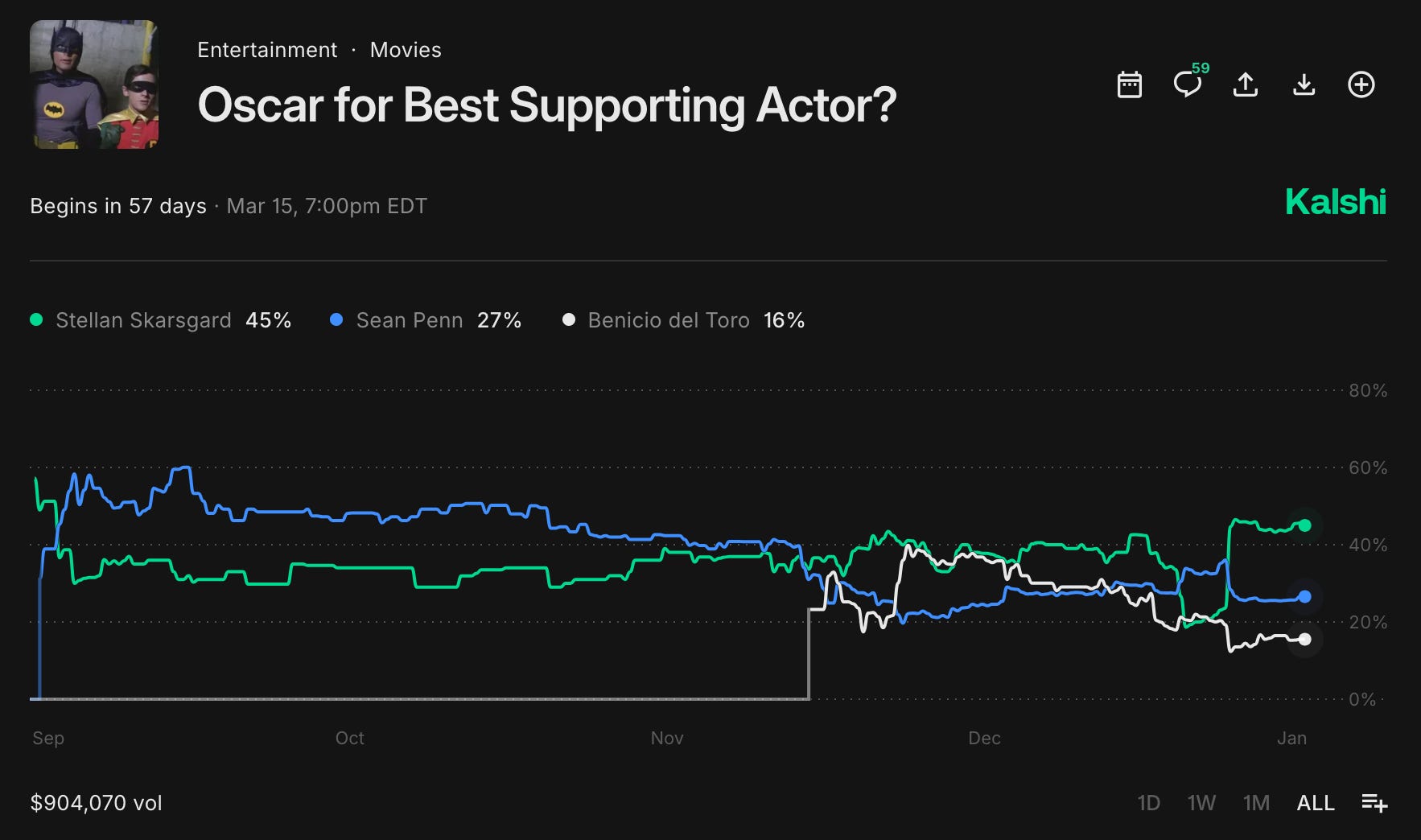
Who knows? I wouldn’t count Sean Penn or Benicio Del Toro out yet. There’s the whole vote splitting thing, but if you are the studio or the distributor, that is a completely solvable problem. I think Stellan Skarsgård has some things going for him, like the lifetime achievement award aspect.
As we talked about, Best Actress has had a clear frontrunner for awhile.
Yeah. I think that one’s obvious. The person I think is going to win is the same person everyone else thinks is going to win. There’s nothing interesting there.
You don’t see Rose Byrne sneaking in for If I Had Legs I’d Kick You?
I don’t. A24 used to have some of the best For Your Consideration staff in the industry. That team has mostly been hired away. You’d have to go pretty far back to see an A24 film overachieving the way Moonlight did. And it is also kind of a horror movie, which works against it.
Let’s talk about Best Actor. Everyone says it’s gonna be Timmy. I think it’s gonna be Leo, but I know you disagree.
I have a hard time seeing it not being him. He has a lot going for him.
We really only have two Gen Z A-listers, and one of them is Timothée Chalamet. From a pop culture and visibility standpoint, he’s going to get rewarded. He’s also at an interesting point in his career where he’s young but he’s paid his dues. He’s been nominated enough times. He’s in almost every scene of Marty Supreme and it checks all the boxes for what you want from an acting performance.
Here’s a stat that goes against Leo: guess how many of the last ten Best Actor winners were also in the Best Picture winner?
One. Cillian Murphy in Oppenheimer. That was a juggernaut year, and Murphy was Oppenheimer. Leo isn’t the movie1.
That said, I’m not sure this is a good bet anymore. The odds have shifted too high. When I got in on Timothée, it was around 65%. Now it’s around 79%.
Well, if you want to pick stats, Best Actor almost never goes to a young man.
But here’s what goes against Leo. If you rank Leonardo DiCaprio performances, this doesn’t crack the top five. If you’re going to reward a known quantity, it’s usually for doing something we haven’t seen before. I don’t think Leo does that in One Battle After Another.
And obviously there’s still a lot that can happen, but not winning the Golden Globe is telling, at least a little. If there’s any awards body not to take too seriously, it’s the Golden Globes. I don’t put much stock in them. But maybe that creates opportunity: markets overcorrecting to Globe outcomes.
Let’s talk about some downballot categories.
There are two at the top of the list. One I think is just an error, and the other I’m hesitant to share because it’s flipped wildly since last night.
The first is Sound. F1 is the favorite but I’m confused by how highly Sinners is rated. If you look at journalists and amateur prognosticators, it’s pretty much all F1. I think the most likely explanation is that folks on Kalshi are betting on this in an uneducated way. This is not score or music, which is why I think people misunderstand the category.
I just checked. F1 is now at 51%2. I got in at around 40%. Did it win at the Globes last night?
No, the Globes don’t have Sound. But the Motion Picture Sound Editors guild released nominations today.
That explains it. And Sinners has dropped dramatically to around 23%. I think if F1 loses, it’s going to be One Battle After Another. But sound is historically one of the least correlated categories with Best Picture, so my sweep thesis applies less here. I still really like the odds on F1.
And tell me about that category where the odds have flipped since you made your initial bets.
The Secret Agent won last night at the Globes, so it’s the favorite now. But I’m very confident in It Was Just an Accident. It’s at 14% on Kalshi right now, which I think is criminally low for a film of that caliber.
There’s pedigree, it beat The Secret Agent for the Palme d’Or. And the narrative is going to carry this one: filmed in Iran in secret, the filmmaker still lives there, and everything that’s going on right now with the protests and violence. That’s easy to lump into a campaign.
The movie is also good. I might like Sentimental Value more, but on its own merits this is a pretty strong movie. And it doesn’t violate the “don’t award bad movies” heuristic. I don’t think The Secret Agent would violate that either. This is a bloodbath category.
Any other categories you think are interesting to talk about, based on the race or the odds?
I think honestly all the ones I thought were interesting have shifted to not being very interesting anymore. Editing was one. I had One Battle After Another at 60% when I got in and now it’s at 70. That’s getting to the point where there’s not much opportunity left. I don’t see it losing this category at all.
So other than that, it’s either obvious picks where the odds are okay, or categories where I have no idea and I’m just not going to play.
I’ve never bet on the short films. It’s chaos, honestly. It would also force me to watch them, which I don’t always want to do. Somewhere in the world, there is a degenerate who loves that category and knows it inside and out. That’s not me.
Do you ever hedge and put bets on multiple nominees in the same category?
I haven’t gotten to that place. I’m thinking about it this year, to hedge against One Battle After Another. I think it’s going to win across the board. But am I overexposed in that investment thesis? Maybe Sinners is going to take it in Cinematography.
But this year feels straightforward. If there were a year to hedge down, it wouldn’t be this year.
Odds change constantly, especially on Kalshi or Polymarket. Does the timing of your bet matter?
It does, but I haven’t fully figured it out since I’ve only started betting on Kalshi a year ago. With a bookie, bets were due a month before the ceremony. That was interesting because the heavy hitting guilds like DGA and PGA hadn’t announced their winners. There was still a lot of uncertainty.
Last year we bet twice. We put down half our money a month before, the rest a week before. We mostly doubled down. We never changed our minds.
And would you ever bet on nominations?
It’s a different game. Narrative and correlation don’t really apply with nominations. It’s more chaotic. I probably would never bet on it because I don’t feel like I have an edge. That’s my philosophy towards betting as a whole. I love risk, but I also love not losing money. Unless I feel I have a real edge, I’m not putting money down.
Right now Oscars betting feels pretty novel, unlike sports where there’s a whole industry built on top of it. Where do you see this going?
How long all this is going to last, I don’t know. If we take a step back and think about how sophisticated Oscars bettors might become over time, it’s possible that we figure out an algorithmic perspective and my betting strategy just isn’t going to work anymore. Five years from now I might not be putting money into this.
Thanks so much for your time Jason. Last question—can I join your pool this year? What’s the buy-in?
Yeah, sure. It’s informal. No fee.
Full Oscars Analysis
Paid subscribers can see Jason’s full breakdown of his Oscars bets below. Updates will be sent in the weeks to come.
Jason's Full Oscars Betting Analysis
This is a follow-up to my interview with my friend Jason, experienced Oscars gambler. It is also the first time I’m paywalling anything, just as an extra bonus for those who do want to do a paid subscription. (At least 90% of what I write will remain free!)
The last time Best Actor and Best Picture went to the same movie was in 2011, when Jean Dujardin won for The Artist.
As of press time, the odds for F1 winning Sound have since jumped to 70%